As SEFS Prepares for the Grand Reopening of Anderson Hall, the Community Reflects on the Building’s 100 Year Anniversary and Looks to the Future
This February the SEFS community will reoccupy Anderson Hall which has been undergoing extensive renovations since the summer of 2024. This year marked the 100 year anniversary of the construction of the building and the SEFS community has had the opportunity to reflect on the building’s history and celebrate all that’s taken place within its walls over the last century – from the evolution of its programs, the celebration of its graduates and the research that has catapulted the school to the forefront of environmental and forest sciences. Since 1925 Anderson Hall has seen upwards of 9,000 graduates walk through its halls and 3,349 of those undergraduate and graduate students have graduated from SEFS since 2005. It’s safe to say that interest in environmental and forest sciences has exploded in the last two decades.
A Brief History
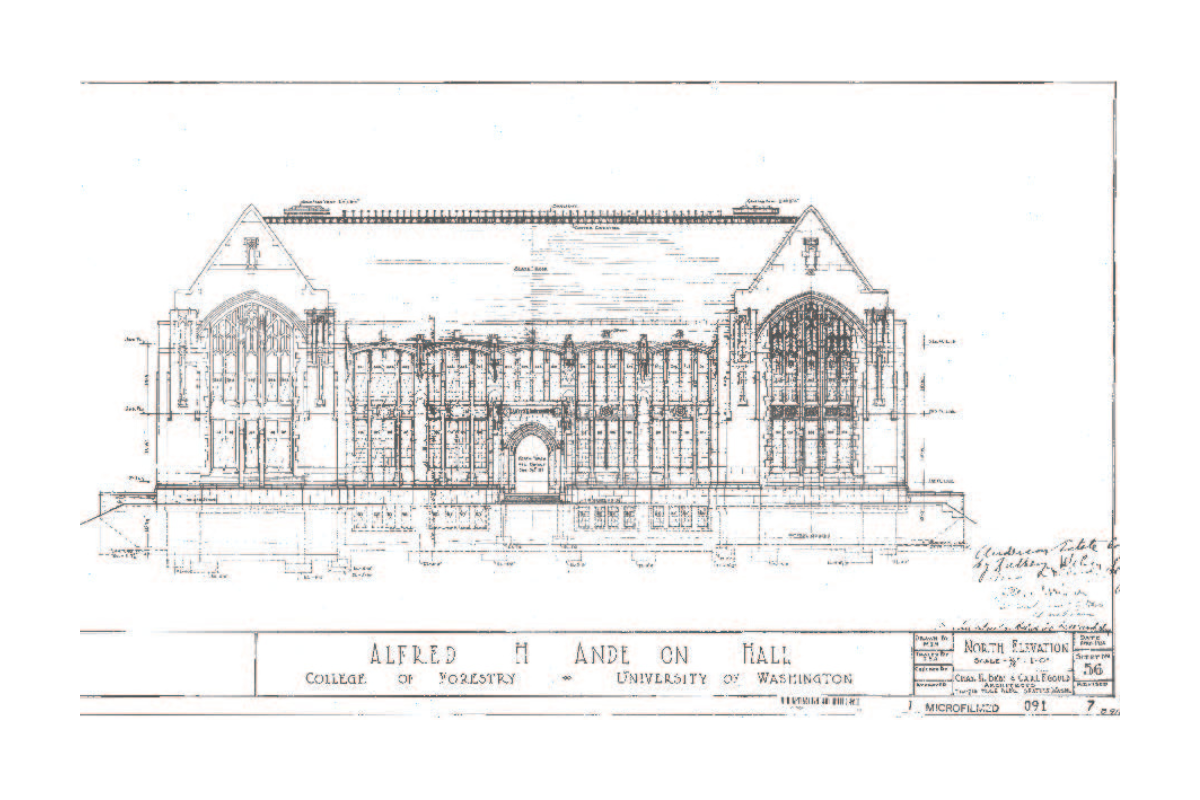
The original architectural design is the work of Carl F. Gould, a partner in the prominent Seattle architectural firm of Bebb and Gould. The first forestry courses at the University of Washington were taught in the 1890s, and at the time of the formal establishment of a forestry education program at the UW in 1907, less than a dozen schools of forestry existed in the United States. By the time Anderson Hall was constructed in 1925, the University had already gained renown for its premiere forestry program, and over the next hundred years the university attracted a wide array of talented and highly impactful students, professors, and researchers from across the world. When the building was occupied in 1925 it housed the College of Forestry until 1969 when the college was renamed the College of Forest Resources to reflect a growing diversity of forest- and environment-related topics the college was teaching. It evolved again in 2008, briefly taking the name School of Forest Resources, then in 2009 becoming the School of Environmental and Forest Sciences. During this time the college and the student body grew as did the research and teaching needs of the forestry program, resulting in the construction of Winkenwerder Hall in 1963 and the demolition of the original Forest Research Laboratory in 1968 that made way for Bloedel Hall. The completion of Winkenwerder and Bloedel formed a shared courtyard with Anderson Hall and for as long as anyone can remember, this area has held one of the school’s most prominent and memorable events – SEFS annual Salmon BBQ.
A Design With Lasting Impact
Standing tall as an emblem of the University’s rich history of world-leading research and teaching in forestry, forest resources and environmental and forest sciences, Anderson Hall was serving more than 1000 students, faculty, postdocs and staff prior to undergoing renovations in 2024. The renovation of Anderson Hall ensures the community that has gathered within its walls since 1925, along with state, federal, tribal, industry and community partners, will continue to advance our fundamental understanding of environmental and forest sciences.
World Class Technology For World Class Learning
SEFS serves as a place for innovation in support of forest-dependent and forest-adjacent industries and livelihoods, and culturally significant uses by diverse Western and Indigenous populations. The School offers the state’s only accredited degree programs in Forestry and in Natural Resources and Ecosystem Management, and a highly regarded accredited engineering degree program. Between 2009 and 2020, we doubled enrollment in our undergraduate programs, now supporting more than 500 undergraduate and graduate students annually. We need a space to meet the learning needs of these emerging leaders, and in February of 2026, we will have one.
An Inclusive And Collaborative Space To Push Boundaries Of Knowledge
A hallmark of the School of Environmental and Forest Sciences is its vibrant and innovative academic culture, one that supports and rewards collaboration. Through a renovation that prioritized collaborative spaces, enhanced technological facilities, addressed long-standing accessibility and safety issues, and modernized building systems, Anderson Hall is just a couple of short months away from becoming a welcoming, inclusive and highly productive space.
Improving Accessibility, Technology and the Student Experience
With input from SEFS leadership, students, faculty and staff, the architectural, engineering, design and construction teams have been hard at work making Anderson Hall a hub for addressing 21st-century problems facing our planet and species. The goal of the restoration and renovation efforts retain Anderson Hall’s legacy of leadership and innovation by meeting the needs of the environmental and forest sciences researchers, students, and practitioners today and for future generations.
Accessible and Representative Common Areas
As the home of Environmental and Forest Sciences at the University of Washington, it is critical that the rehabilitated building reflects our community and school’s commitment to sustainable management and stewardship of natural resources and ecosystems. The conceptual framework for the design of new interior spaces was inspired by the unique character and history of SEF’s field research sites, ranging from the forests of Mount Rainier to the coastal environments of the Olympic Peninsula. Each common area tells the story of these places and the program through quality of daylight, color, materiality and use of salvaged wood from the building and other campus projects. Our community was convened early in the process to identify space needs, collaboration opportunities, and required adjacencies.
Salvaged and Repurposed Materials Get A Second Life in Anderson Hall
The historic wood slabs previously hanging in the Auditorium have been repurposed and thoughtfully integrated into the new spaces. The two largest slabs that were recovered during the early phases of the project have been incorporated into feature walls in the SEFS Commons and Level 1 Collaboration spaces, supporting storytelling concepts and connecting those spaces to our program’s history. At the SEFS Commons, the Western Red Cedar slab includes a graphic etching developed with input from a cross-section of stakeholders. The two smaller slabs are being incorporated into common area furniture, including a bench near the interstitial opening, and a large collaboration table in the faculty suite.
Accessibility Improvements
Providing accessible, inclusive, and welcoming spaces were core tenets of the project, informing the approach for key aspects of the design. Accessibility improvements include:
- A prominent new south entry and outdoor terrace that provide universal access and promote a sense of belonging through courtyard activation, visual connection, new collaboration areas, and improved daylight penetration at the interior
- An elevator will allow access to all floors of the building
- Fully modernized and accessible interior spaces, including all-user restrooms
- Accessible furniture and wheelchair charging stations
Materials Decisions
The design emphasizes sustainable materials through use of salvaged wood, low-VOC interior finishes, and reduced embodied carbon compared to a typical building or a newly constructed building. In addition to using the SEFS slabs, the team coordinated with the UW Carpentry Shop to incorporate salvaged wood at the reception desk and key pieces of furniture throughout the common areas. Tracking LEED Gold certification, the project earned credits for incorporating low-emitting materials that reduce concentrations of contaminants that impact the environment and human health. The project team also achieved a significant reduction in embodied carbon through reuse of existing materials and incorporation of lower carbon new materials.
Hennebery Eddy Architects in partnership with Lease Crutcher Lewis have been hard at work collaborating on this transformational renovation. To see conceptual renderings of Anderson Hall’s south entrance and interior please visit the Hennebery Eddy site.
To learn more about design and construction milestones and view pictures of construction progress please visit our page dedicated to Reimagining Anderson Hall.
We invite you to stay tuned for an invitation to a spring ribbon cutting ceremony and tour the revitalized building in 2026.