Breathing Nature In: How Our Environments Shape The Nasal Microbiome and Human Well-Being
The benefits of nature exposure for human well-being are well-recognized, yet much remains to be understood about the underlying mechanisms as to how these effects occur. Research out of UW’s Environment & Well Being Lab led by SEFS’ graduate student Connor Lashus is helping us close the gap in understanding the role that microbes in the human nose might play in the relationship between nature exposure and well-being. With this pilot study, Lashus and his team explore the connection between our nasal bacteria and well-being after long-term nature exposure.
Over the summer of 2024, a small group of students from Seattle either spent eight weeks living and working in remote forest environments in western Washington or remained in urban Seattle. Before and after this period, Lashus measured participants’ mental well-being using validated surveys and collected nasal swabs to analyze the specific types of bacteria living in their noses, allowing the team to compare participants’ nasal microbiomes before and after the summer exposure period. They also collected air samples in the forest environments and compared the bacterial content of those samples to the bacterial content in participants’ noses. This allowed them to begin assessing the degree to which the forest aerobiome may have influenced participants’ nasal microbiomes over the study period.
Students who spent the summer in forest environments showed greater improvements in positive mood and reductions in negative mood and rumination compared to those who remained in the city. These psychological changes were accompanied by measurable differences in their nasal microbiomes, including higher bacterial diversity in the forest group post-exposure, as well as increased abundance of specific bacterial groups that have been previously linked to beneficial effects on human health and well-being. This change was not observed in the urban group.
Importantly, these microbial changes were closely associated with improvements in mood across all participants. In addition, students in the forest group—but not the urban group—showed increasing compositional overlap between the bacteria in their noses and the bacteria present in the forest air over the study period. While this was a small, exploratory study, the findings suggest that immersive exposure to natural environments may influence mental health in part through biological pathways involving the nasal microbiome—pointing to new directions for research on nature, health, and the human–environment connection.
Q&A with Connor Lashus
Can you share more about where the participants lived during this pilot study?
Connor Lashus: Our participants lived either in Seattle for the summer or at one of two forest field sites in western WA – the Olympic Natural Resources Center (ONRC) near Forks, WA or the Center for Sustainable Forestry at Pack Forest (PF) near Eatonville, WA.
Can you tell us more about the specific bacterial groups that have been previously linked to beneficial effects on human health and well-being? What does previous research suggest?
CL: Two of the interesting bacterial groups we found to be more abundant over time in our forest—but not urban—group were the genera Bifidobacterium and Akkermansia. Our classification only reached the genus level due to the type of sequencing we conducted, so these are broad groups of bacteria containing many species and even strains within a species, and those species and strains could do different things, so deeper classification would be required to say whether the bacteria we observed are those that have been specifically linked to beneficial health and well-being effects.
Additionally, many of the links to beneficial effects have been studied in the context of these bacteria in the gut, rather than the nose. Whether similar or related mechanisms take place in the nose is a current topic of much investigation. These caveats aside, members of the Bifidobacterium genus in the gastrointestinal tract have long been associated with a range of beneficial health outcomes, from the gut to the brain. For example, members of the genus produce compounds called indoles from their metabolism of the amino acid tryptophan. These indole metabolites can help keep inflammation in check and support the integrity of the gut lining. Evidence from animal models suggests they may also contribute to reduced inflammation in the brain and support improvements in cognitive function. Akkermansia, on the other hand, is often referred to as a “next-generation probiotic,” as its potential to confer health benefits has only more recently been recognized. Like Bifidobacterium, members of Akkermansia have been linked to well-being-promoting regulation of inflammatory response. Studies suggest it may also help alleviate stress and increase the production of molecules that support neuroplasticity.
What’s next for this research? What do you hope others will borrow from your research and expand on?
CL: This is just the beginning. This pilot study was very small and very exploratory. Our goal was to get an initial sense of whether this connection between nature exposure and human well-being through the nose and nasal microbiome was something worth investigating further, and we think our results suggest it is. Moving forward, the focus is on replication in larger and more diverse samples and using study designs that allow us to more directly investigate cause and effect. For instance, we’re currently in the planning stage for a randomized controlled trial (RCT) to examine the effects of a short-term nature vs. urban exposure on the nasal microbiome and multiple dimensions of well-being. Another focus going forward will be what we refer to as the “active ingredients” of nature exposure. We’re interested in finding out what specific environmental features—volatile organic compounds, air pollutants, airborne microbes—may be important when it comes to effects natural environments may have on the nasal microbiome and our well-being.
What were some of the big takeaways that surprised you about the results of the validated surveys? Is it what you hypothesized?
CL: Due to the great work done in the past by our lab and others investigating nature’s beneficial impacts on well-being, our survey results were fairly unsurprising and in line with what we hypothesized. Consistently, nature exposure is associated with improvements in psychological well-being.
What previous research inspired this pilot study? Now that it’s been completed is there anything that you might’ve altered or changed about the project?
CL: This work is very interdisciplinary, so our inspiration came from numerous sources. One of the primary drivers was the working group led by Dr. Bratman in 2024 called Nature and Human Well-being: The Olfactory Pathway, of which the framework paper in Science Advances by the same name is a product. This meeting of experts from around the field of olfaction came to a consensus that nature likely impacts human well-being through mechanisms specific to the olfactory pathway. Furthermore, they agreed that the nasal microbiome was an understudied, yet potentially critical factor to consider in the relationship. The rich and growing field of nature and health research was also a primary inspiration, from the Shinrin-yoku (forest bathing) studies conducted by Dr. Qing Li to the work of UW’s Center for Nature and Health, which includes Drs. Howard Frumkin, Peter Kahn, Josh Lawler, Michelle Johnson-Jennings, Usha Varanasi, Edmund Seto, and others. Beyond that, our thinking around nature exposure and human microbiomes has been informed by an expanding body of work from multiple research groups, including work by Dr. Martin Breed and Dr. Jake M. Robinson at Flinders University in Australia, as well as Dr. Graham A. W. Rook’s work on microbial ‘Old Friends.’
Now that this project is complete, the primary thing I would have loved to change is the sample size. It would have been great to have a larger sample for more power in the interpretation of our findings. Also, it would have been great to collect another round of follow-up measures 8-weeks after all participants returned to Seattle. That way we could assess whether the changes we observed persisted or returned to a baseline.
What can the average person take away from this study? For the many city dwellers out there, what would you suggest in the way of nature exposure? Where are your favorite places to escape to in the city or nearby?
CL: Beyond this study alone, I think the research is clear that spending time engaging with natural environments can have positive impacts on your health and well-being. However, the present study is far too preliminary to come to any solid conclusions about operationalizing the results. More research in larger cohorts with tightly controlled experimental conditions is necessary before we can make any sort of recommendations. That being said, I think the primary takeaway from our study should be that many of the biological mechanisms behind nature exposure’s well-being benefits remain largely underexplored, and there is still so much to learn regarding the complex interconnections between humans and our environments.
Personally, I love getting outside – it’s part of what motivated me to come to Seattle. This region offers incredible opportunities, from a fantastic park system here in the city (favorites include Green Lake and Maple Leaf Reservoir Park) to bigger wilderness areas outside of it. I love to run and bike in the warmer months and ski when there’s snow, so I spend a lot of time around Tiger and Cougar Mountain, as well as up and down Mt. Baker-Snoqualmie National Forest. I recently brought my 1.5-year-old son Doug on his first ski tour near Crystal Springs – he had a blast.
What do we already know about the importance of the nasal microbiome?
CL: The majority of existing research into the nasal microbiome has come from the perspective of respiratory health and local microbial communities’ connections with conditions like asthma, allergic rhinitis, and chronic rhinosinusitis. It includes bacteria, viruses, and fungi. It is typically dominated by bacteria from the phyla Actinobacteria, Firmicutes, and Proteobacteria, but its more granular composition and diversity varies between individuals, affected by factors like age, genetics, health status, geographic location, cohabitation with animals, air quality, and medication usage. Increasingly, nature exposure is recognized as another one of these factors. In terms of its influence on psychoneuroimmunological outcomes, research is only just beginning. Over the last two decades, the gut microbiome has dominated research exploring connections between resident microbial communities in humans and mental health, but the microbiota of the nasal passages are well positioned anatomically to influence the central nervous system. The nasal microbiome’s role in neuroinflammation, neuroendocrine signaling, olfaction, and psychological well-being is an exciting emerging field of inquiry.
Tell us more about your air sampling setup. Why was this a critical component of the pilot study?
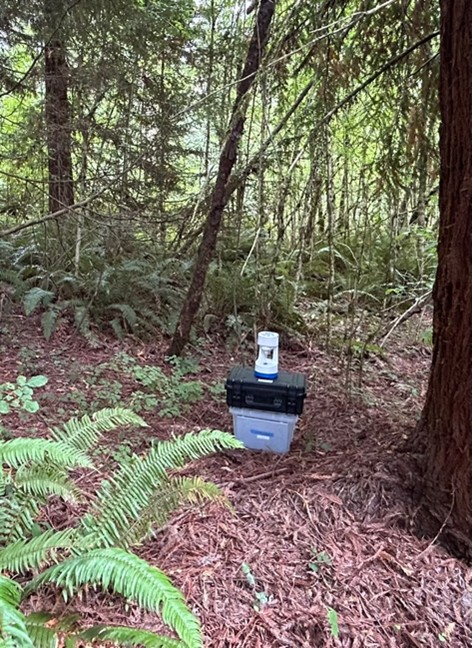
CL: We used an instrument called the CoriolisⓇ Compact Microbial Air Sampler. It’s positioned about 1 meter off the ground, and air is drawn into a sampling inlet and vortexed around the inside of a sample collection cone for 20 min. Then we add a nucleic acid preservative solution to stabilize any DNA that accumulates over the sampling period, extract that DNA, and perform a sequencing procedure that allows us to specifically determine what types of bacteria were in the sampled air. This is a critical piece of our exploratory study, because we are interested in the active ingredients of nature exposure that could play a role in shaping human nasal microbiomes and downstream well-being outcomes. The microbial content of the air—the ‘aerobiome’—is a potential contributor we are investigating.
Read more about the pilot study and the research in Environmental Research
Acknowledgements
We would like to thank Dr. Gregory Ettl, Director of the Center for Sustainable Forestry at Pack Forest, and Dr. Bernard Bormann, Director of the Olympic Natural Resources Center for their support in completing this study. The work could not have been accomplished without their cooperation in allowing us access to both study sites, which provided excellent settings for our forest exposure condition.