landscape architecture firm, SiteWorkshop, shares insight into Anderson Hall’s green landscape design
Near the completion of Anderson Hall’s landscape design we met up with SiteWorkshop Landscape Architect Cyrus Deloye who received his MLA right here at the University of Washington. Cyrus worked on Anderson Hall’s native and locally influenced meadow design and shared some of the firm’s inspiration behind design decisions and some of the challenges they faced in designing a landscape that would support the growth of native plants while suppressing non-native plant growth on site.
Can you share the team’s inspiration behind its selection of native plants, shrubs and trees and why they are a good fit for the location?
The planting concept celebrates the region’s native flora, while also highlighting climate resilience with the inclusion of species from further down the west coast. Already, many native species (especially in urban settings, but also in the wild) are declining due to a changing climate and related challenges. While many of our native prairie species, for example, are reasonably well adapted to future conditions, in managed landscapes we also need to think beyond historical plant distributions and select plants for their tolerance of hotter, drier conditions. For instance, we included a number of Arctostaphylos and Ceanothus cultivars from California for this reason, as well as for their potential to provide forage for native bumble bees early in the season. Facing an uncertain future, we tend to err on the side of increasing taxonomic diversity to improve resilience, and that often means drawing on west coast plant communities that were spared the last ice age.
Can you share more about SiteWorkshop’s concept of a native and locally influenced meadow design?
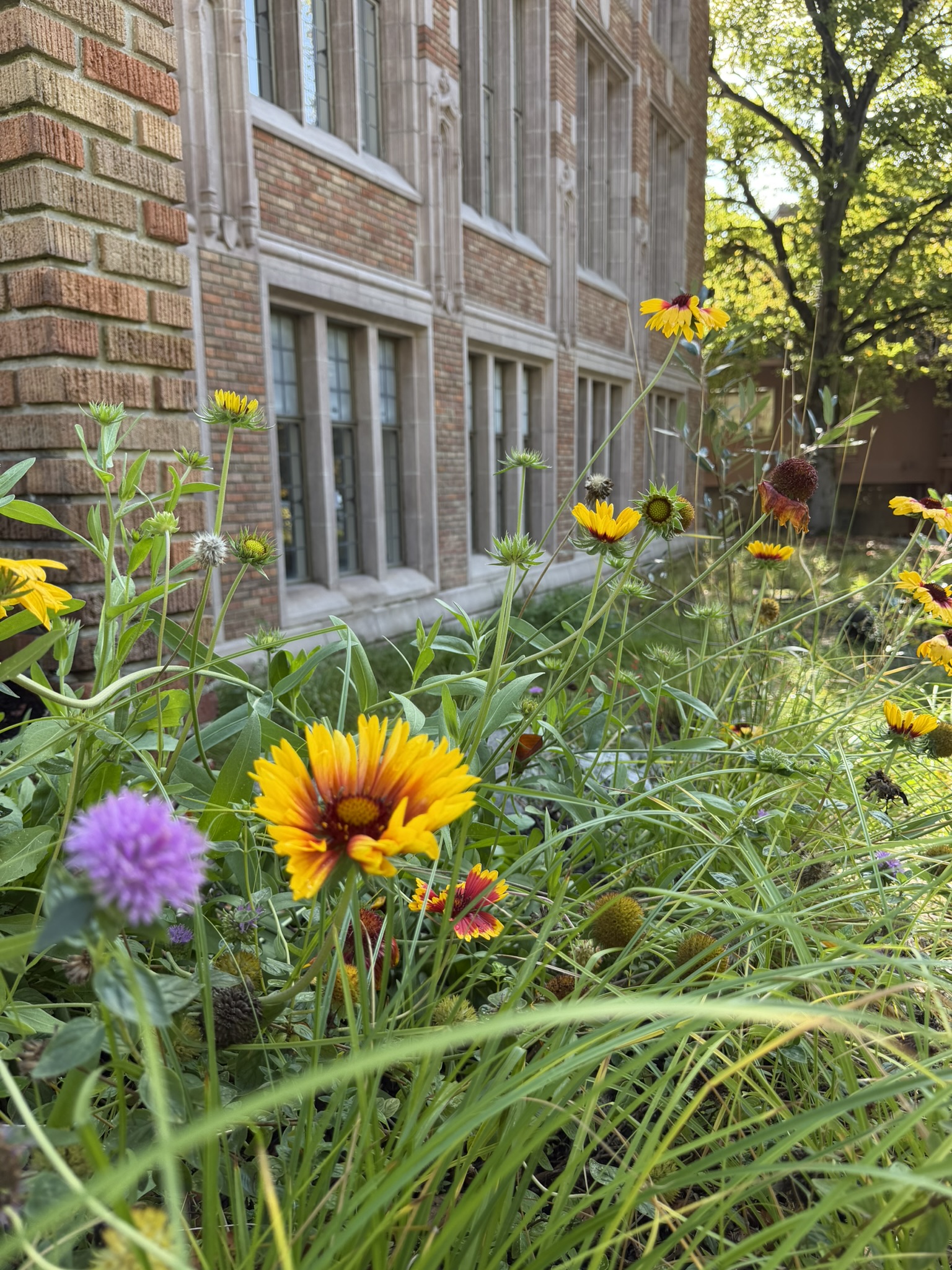
The meadow is a response to a few design priorities. Aesthetically, it is important to preserve views of the historic building, so a low landscape makes a lot of sense. Functionally, it also facilitates maintenance access to the façade and windows, which had been a challenge before this renovation project began.
More broadly, there was a strong interest in delivering a landscape that can support biodiversity in a robust way (something also highlighted in the UW Campus Landscape Framework published in 2015). Since they can pack a lot of plants into a small footprint, meadows are well positioned to offer diverse forage and nesting opportunities for wildlife, especially for pollinators. Meadows also complement the wooded landscapes that surround Anderson Hall, increasing local structural complexity and therefore overall habitat value.
While interest in native meadows continues to increase for designed and managed landscapes, it can be challenging to implement them in ways that are appropriate to available maintenance resources. With that in mind, the meadows at Anderson Hall aren’t exactly what you would see in the context of, for example, a Puget Sound prairie restoration project. Here the design challenge is to reduce the maintenance burden as much as possible, while still providing a diverse range of plant species. We rely on closing the plant canopy relatively low to the ground to suppress weed recruitment (using primarily Carex pansa and Carex vulpinoidea), then integrating a variety of fobs that can grow above that canopy to withstand the competition from the sedges.
What are some of the challenges and opportunities to support the growth of native plants and suppress non-native plant growth on site?
The soil strategy is deliberate, and adds a bit of stress to the system to check the growth of competitive species—native or non-native—and to slow down any ruderal species that may get established. Basically, we’re trying to reduce the maintenance burden with a specific soils approach.
For general context, the Department of Ecology Stormwater Manual requires soils for projects in Washington State to be amended with high levels of compost, regardless of which plants are being grown. Unfortunately, the increased levels of productivity (well beyond most native soils) makes it very difficult to grow a diverse meadow of native grasses and forbs without investing a lot in on-going management. The most competitive species (often graminoids, native or not) quickly dominate at the expense of slower-growing, more stress-tolerant species (ruderal species too, such as our showy native annuals). Without gardener resources to keep those competitors in check with regular disturbance (usually cutting back), diversity is quickly lost.
As an alternative, we add a wee bit of stress to the landscape by specifying a mix of sand and compost that is typically used in bioretention planters. Because this mix omits a loam component, it tends to drain faster than a standard 3-way soil mix. (Using a deep layer coarse sand would also reduce nutrients and can be highly effective for this application, but sand is more expensive than a bioretention mix.) As long as summer irrigation is kept to a minimum, the dry season can do a lot to suppress competitors and ruderal weeds, creating less work for the gardeners.
We also used a three inch layer of sand as a mulch in the north meadow. This increases the stress a bit further, especially for seed rain (and deeper would be more effective still), while also mitigating compaction from foot traffic. With appropriate plant specification, stress can be a wonderful management tool, especially for public landscapes.
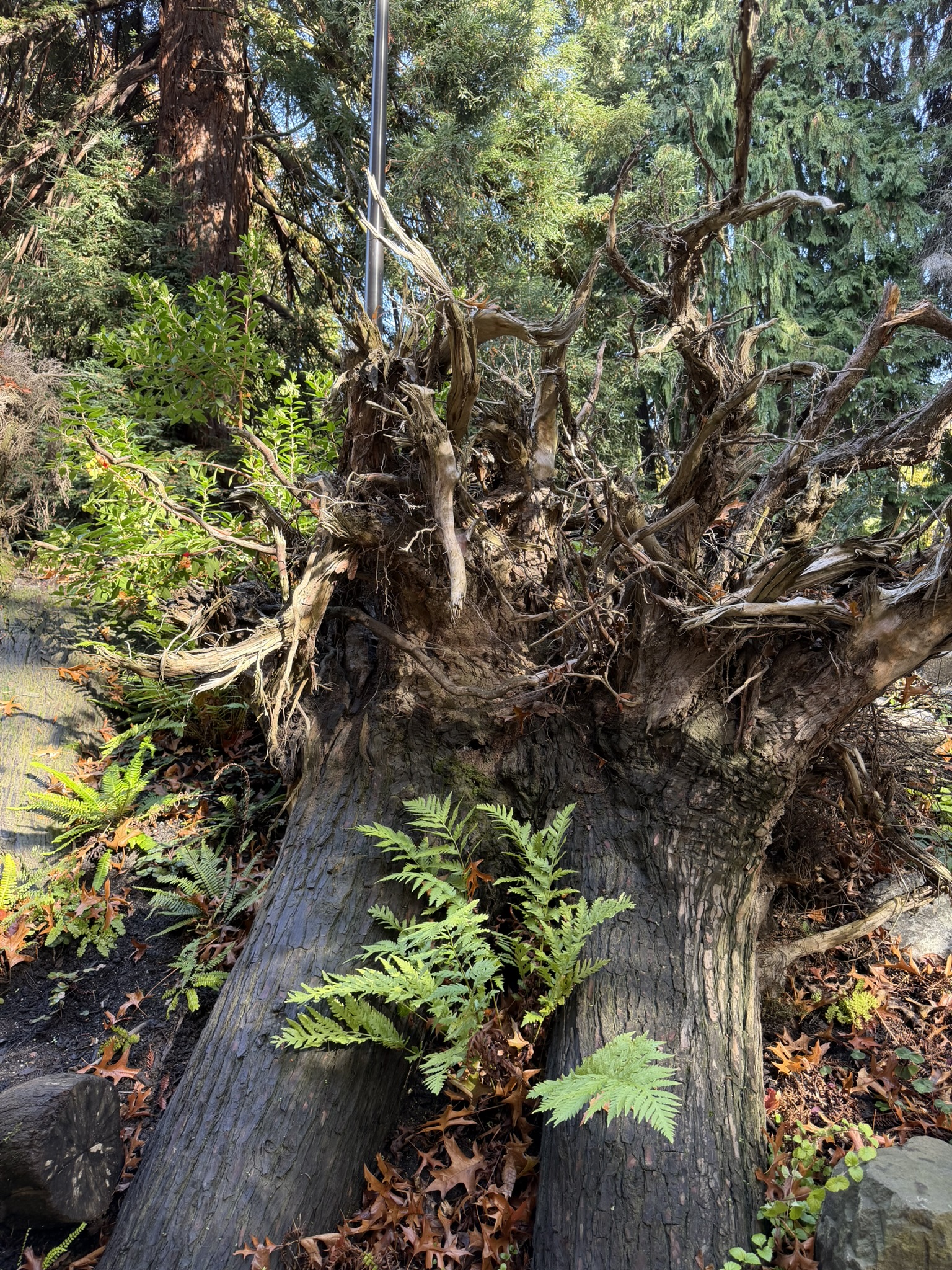
There are a handful of large turned-over stumps on the property. Will there be any future intervention here or is the intention to let nature take its course?
The scope of this project required the removal of a few trees, including some very special ones. Leaving some of these trees on site in some form seemed like an appropriate way to honor them, while also allowing them to continue to contribute habitat, even in death. Already the detritovores are busy at work, which will offer food for other species, and we hope to see the stumps used as nesting opportunities as well. We also expect to see epiphytic plant species start to colonize the stumps over time (we had originally specified some epiphytic ferns for these spots, but nursery availability proved too challenging this year; we did add some vines, though).
We also hope to help normalize seeing dead wood in managed landscapes, especially as prominent features. Dead wood is a great way to increase structural complexity for habitat, especially in a meadow.
Otherwise, we relied on our own professional experience designing meadow landscapes to ensure nursery availability (very challenging these days), ease of maintenance (meadows can be challenging), and potential to support biodiversity.